O’ Lord ! O’ My Lord ! May I never forget You !
|| Shri Hari ||
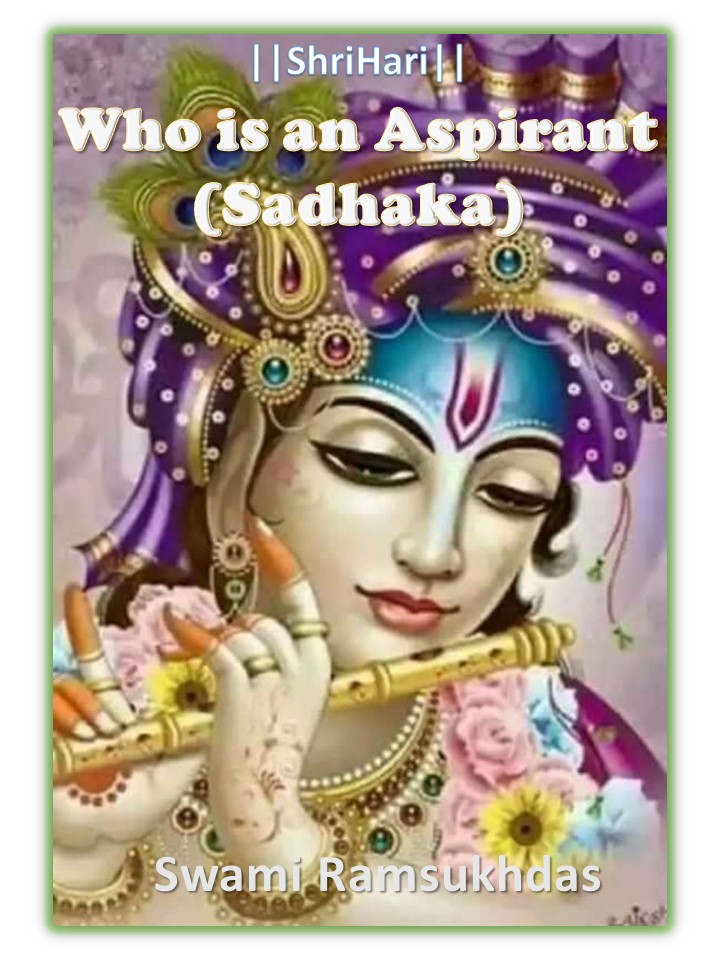
Who is an Aspirant (Sadhaka)
tvameva mata cha pita tvameva
tvameva bandhuscha sakha tvameva |
tvameva vidyaa dravinam tvameva
tvameva sarvam mama devadeva ||
Swami Ramsukhdas
|| Shri Hari ||
Who is an Aspirant (Sadhaka)
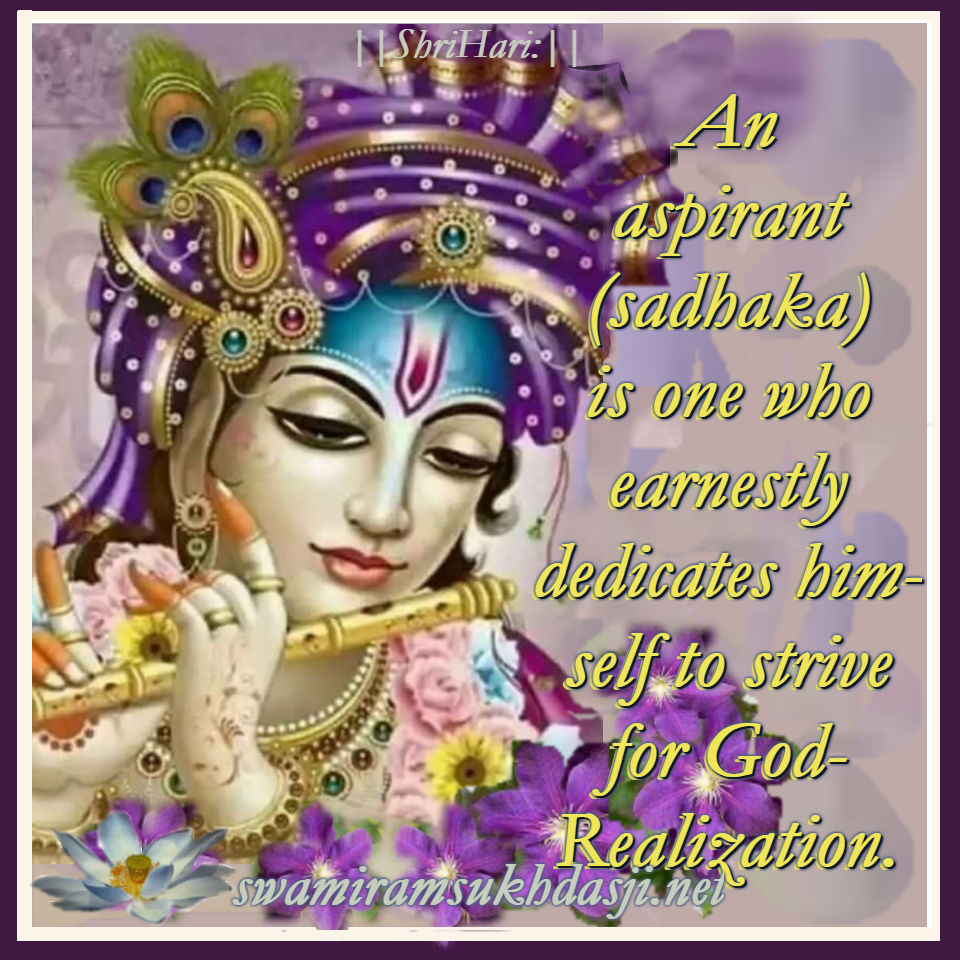
An aspirant (sadhaka) is one who earnestly dedicates himself to strive for God-Realization, and one who does not do anything that is opposing to his goal, objective of God Realization, i.e. one who does not follow practices that are against or adverse to his spiritual pursuit. Worldly pleasures with objectives of hoarding and desire are all negative aspects for a devotional undertaking. There can be no spiritual progress in a person's efforts until money, power, high status, comfort etc., and other desires and attractions co-exist in him; and he can not be called an aspirant (sadhaka).
Sometimes spiritual interest and inclination and other times worldly attractions; sometimes virtuous conduct and other times bad behavior – in effect, along with devotion to God, such contrary feelings are present in all common persons. In some persons spiritual conduct may be prominent while in others, contrary feelings might dominate.
Being a fraction (part) of God, there is none who does not possess an element of goodness inherent in him. The good aspects permanently persist, but the adverse ones are temporary. When one makes even minor efforts for good behavior, he may think of himself as an aspirant, but he is mistaken. Only such a person could rightly be called an aspirant (sadhaka), who in fact, does not conduct himself badly, nor is influenced by worldly pleasures and desires, nor aims at hoarding.
He who believes that - as such I am not an ascetic! I am a householder and live in the world, for earning money, I have to use falsehood, deceit and dishonesty etc., because without doing so, I may not earn money and succeed. Such a person cannot be an aspirant (sadhaka), rather, he is a "worldly man". On the other hand, if one believes that he is an aspirant and is solely interested in God-Realization, therefore, how he could act contrary to his spiritual discipline, such a person verily is an aspirant. He believes that in maintaining his life, he does not have to lie, cheat, be deceitful or dishonest etc. God is responsible for the overall working and sustenance of the world, the responsibility is not theirs. If one dies without food and water, then could he evade death with food and water? Nobody can die, before death is due, so why worry about maintenance and support of this life?*
*Praarabdh pehle racha peeche racha shareer
Tulasi Chinta kyon kare bhaj le shree Raghubeer
‘The fate was determined first and then came the body. Why should I worry, I should only worship Raghuvira.’
If a person is of worldly nature, his worldliness constantly persists and the way he acts in worldly matters, in the same way he performs spiritual practice (saadhana). Devotion is constant in an aspirant, i.e. the way he attends to his spiritual aspirations, in the same way he looks after his worldly responsibilities. A person enamoured by worldly matters, attends to these with deep involvement, but practices spiritual discipline being detached (only as a matter of formality or routine), but an aspirant undertakes his spiritual duties with deep involvement and carries out his worldly actions, without attachment (merely for doing his duty).
Carefulness by itself is the spiritual means (sadhana). An aspirant is always careful, lest he should do anything that is contrary to his spiritual discipline! When faced with attraction-aversion (raga-dvesh), passion- anger (kaam-drodh), he does not take action under their sway (influence).* If due to habit or by mistake, an act is performed against the best interest of his l aspiration, it is not by deliberate intention. Because it is not his aim or objective to do any work that is against his spiritual discipline.
*Gita 3/34
‘Attraction and repulsion, of man abide in each and every sense object through the feeling of agreeableness and disagreeableness (towards the senses). Let no one come under their sway, for they are his waylayers and foes.’
Just as a person makes money and from time to time spends it, then he is really not greedy for money. If he were really greedy, he would not spend it, but instead face hardships. If it costs him a few rupees (dollars) to travel a short distance, he would undergo the trouble of walking it, but he would not spend the money. An aspirant must also have insatiability for his spiritual discipline (for God realization). Just as a very tiny particle in the eye cannot be tolerated, similarly even the slightest bit of mistake in his spiritual discipline should not be tolerated. An aspirant (sadhaka) who is hungry for his spiritual pursuits, suffers much pain, undergoes deep regrets, has great remorse about any action that is contrary to his spiritual discipline. On experiencing such repentance, he stops doing anything contrary to his spiritual discipline (devotion).
God is neither realized by a woman, nor a man, nor an ascetic, nor a householder, nor a Brahmana, nor a Kshatriya. In other words, God is not realized by any particular distinction of class, caste, category or community, etc., but only by a sadhaka (spiritual aspirant, devotee). The gist is that an aspirant does not have the vanity of belonging to a special caste, class, community etc., nor gets influenced by these, nor has a feeling of superiority over others.
Question - What is the mark (sign) of an aspirant?
Answer - The mark of an aspirant is that of forsaking attachment to the world (vairaag) and loving God.
Question - What is the difference between a good person and an aspirant?
Answer - A person with good character, virtues, good qualities and behavior is a good man; while he who has a yearning to realize God or to attain salvation is an aspirant. A dedicated devotee (spiritual aspirant) is a good person, but the contrary is not necessarily true. An aspirant is one who supports his faith and sect, but at the same time does not criticize, condemn or hate those of others.
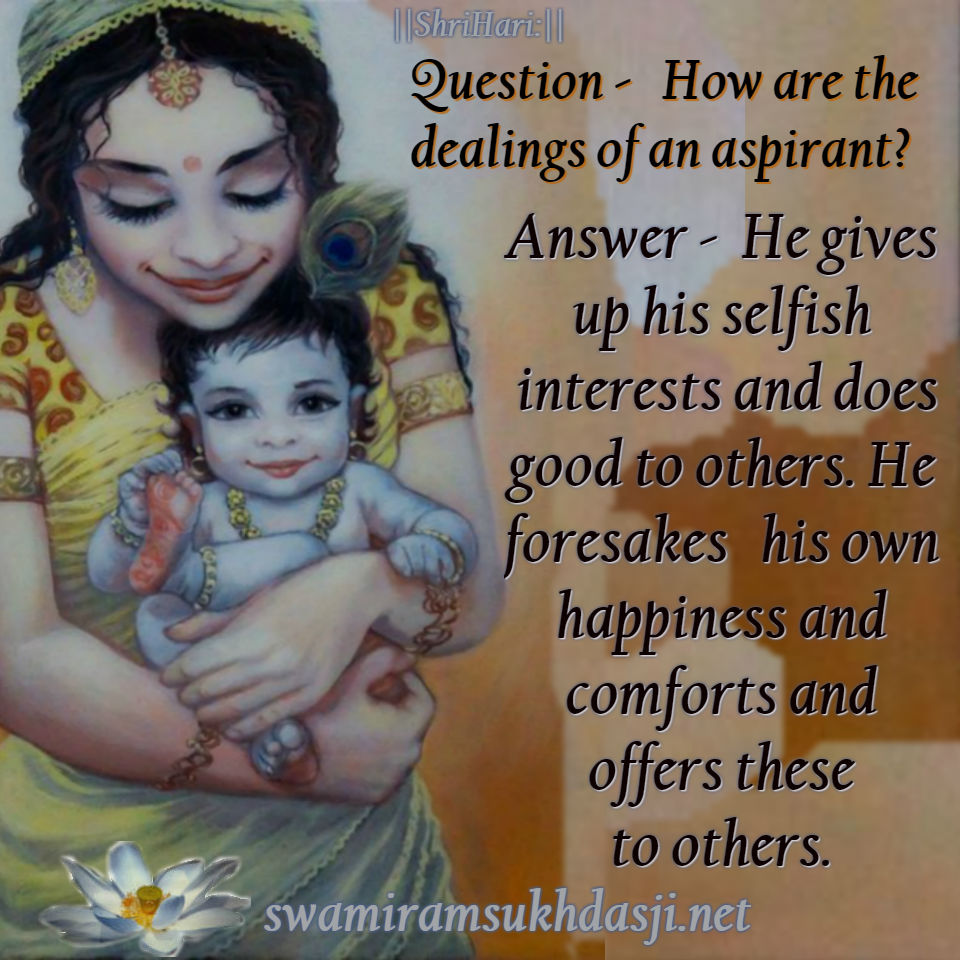
Question - How are the dealings of an aspirant?
Answer - He gives up his selfish interests and does good to others. He foresakes his own happiness and comforts and offers these to others. He without expecting honor and respect from others, imparts honor and respect to them - "sabahi maanprad aapu amaani" (Manasa 7/38/2), "He gives honor (respect ) to others even at his own cost". He does not have bad feelings towards anybody. If he sees any fault in others, he believes that the fault belongs to their bodies, their inner senses, their nature and habits, but not to their "self" (swayam). Like if a person's clothes get a stain, then he himself is not stained; similarly, if there is a defect in someone’s mind,, his self is not defective. So an aspirant does not assume others to be bad and so he does not appear to be bad to others. The Gita says -
"yasmaanodvijate loko lokaannodvijate cha yah" (Gita 12/15); "
He by whom no being gets agitated and who is not agitated by any being."
Question - When does the spiritual practice begin in human life?
Answer - Dedication (spiritual practice) begins when a person is distressed with the world or if he begins to think / reflect on life. When a person gets no pleasure, nor peace from the world, when he has affection for others, and from whom he expects to receive happiness or has hopes of happiness, and they let him down, then a feeling of despair overtakes him. He begins to feel uneasy regarding the current state of affairs. In such a state, the desire (and need) to attain happiness that is constant (ever-lasting), imperishable, immutable and free from any pain and suffering awakens within him. He aims to achieve the bliss which is devoid of sorrows, which is without an end and without a fall and which cannot be separated from him. With such an objective, his spiritual discipline (sadhana) begins.
A person who turns to God and engages in spiritual disciplines only due to becoming disgusted with the world, then on getting worldly happiness, he could deviate from his divine objective. However an aspirant with deep dedication and contemplation cannot go astray; because it is the aspirant's objective to achieve that bliss, which is without even the slightest bit of sorrow once and for all. Without that bliss he is not satisfied with any place, time, thing, person, condition or circumstance.
If somebody is unhappy with the world and desires to get rid of his sorrow through worldly happiness, then he is a worldly person, not an aspirant. The reason is that he has faith in worldly happiness, which cannot be the result of his devotional perception and understanding. Worldly happiness cannot dispel worldly sorrow, that is the rule. Unhappiness precedes worldly pleasure and end with it. It is the same in the middle, whether one perceives it or not, The reason is that anything that is at the beginning and the end, is also in the middle state – this is the principle. When a person understands that worldly happiness in truth is nothing but a form of unhappiness and person desiring happiness can never be free from misery, then his spiritual discipline begins.
Question: What is the form (nature) of spiritual discipline?
Answer: It is renunciation (tyaaga), reflection (vichaara) and surrender (sharanagati,i.e. calling out to the Lord).
Not to do anything for one's own happiness, but only to work for the happiness of others – this is renunciation (Karmayoga)
From childhood to now, this body has changed completely, but "I" (self) is the same and it has not changed, this is discrimination, it is reflection (jnanayoga).
Believing that I am unable to do anything; and with such feelings, giving up the reliance of one's own strength and surrendering to God. That is self-surrender (Bhaktiyoga).
Question - What are the main impediments to spiritual discipline (sadhana)?
Answer - Attachments to sensual pleasures is the main impediment. This obstruction stays for a long while in his spiritual discipline (dedication). Wherever he enjoys pleasure, he gets stuck; so much so; that if he relishes even deep trance and deep meditative super-conscious state (Samadhi), he gets trapped. Attachment to good, pure happiness (sattvika sukh) also leads to bondage. The Gita says – "sukhasangena badhnaati" (Gita 14/6); That is why the Lord has said in the Gita "jnanino nityavairinaa" (Gita 3/39); "The desire for happiness is the constant enemy of the wise."
These days an aspirant remains engrossed and passionate about gaining maximum progress in his dedicatory efforts, and about increasing his knowledge, yet he does not direct his energy to the getting rid of attachment to pleasures. It is due to this attachment that an aspirant does not get success immediately, in other words, in the present he does not gain perfection and it takes a long time. Therefore it is extremely essential to get rid of attachment to pleasures.
In reality, God is ever present, the Guru (spiritual guide) is also present; also the "Essential" knowledge for Self-Realization, Truth (tattvagyaan) is present, and the capabilities, competencies and abilities are also ever present in us; only the attachment and infatuation to temporary and perishable pleasures is the main obstacle in manifesting and revealing these. The responsibility of effacing and wiping out this attachment to pleasures is on the aspirant; because he himself has created this attachment and become infatuated. Therefore Lord Krishna says in the Gita –
Uddharedaatmanaatmaanam naatmaanamvasaadayet |
Aatmaiva haatmano bandhu raatmaivaripuraatmanah ||
(Gita 6/5)
"It is up to man to emancipate himself by his own self and not degrade himself, as man is his own friend and he is his own enemy."
Question: How to eliminate attraction and attachment to pleasures?
Answer: There is an excellent remedy to be free of attachments to pleasures - it is to be happy in the happiness of others and to share the sorrows of others with compassion - "par dukh dukh sukh sukh dekhe par" (Manas 7/38/1).
On seeing a happy person, feeling happy along with him, an aspirant becomes unison with his happiness, by which the other person experiences joy. Similarly on seeing an unhappy person, an aspirant becomes compassionate towards him, and shares in his sorrow, and thus the person does not have to bear the entire brunt of the suffering alone, by which it lightens up his sorrow and he feels happy.
By feeling happy with the joy of others, a person's own desire for pleasure lessens, because the pleasures derived from self-indulgence, that same pleasure is specially derived from seeing others happy, by which he does not feel the need to seek enjoyment for himself. Similarly, on sharing other's distress, whatever the means (things), abilities, capabilities etc. an aspirant possesses, these are naturally diverted to reduce other's distress, with the result that his own desire for hoarding, collection, prosperity reduces. In this way, through sharing other's happiness and distress, an aspirant's propensity towards enjoyment (sense pleasures and accumulations) is reduced and eventually is wiped out.
An aspirant who co-shares the joys and sorrows of others can endure his own sorrows cheerfully and willingly, but he cannot endure the distress of others. While indifferent to his own suffering, he cares much for the pain and distress of others. If an aspirant has the primacy of renunciation and dispassion then he does not feel the pain of his body nor does he seek pleasure from others. He cannot bear to draw happiness from others and if others extend it to him of their own, then he is not pleased with it.
Question - What are the other means of discarding attachment to pleasure (sukhaasakti)?
Answer - If there is firm faith in God and one approaches Him with heartfelt cries, the desire for pleasure can be overcome. If one decides determinedly, that, he has not to seek pleasure, then it does not take long to wipe out attachment to pleasure. In fact, happiness is not for taking, but only for giving -
Also by keeping the company of great souls, who have no desire for worldly pleasures and have faith and love for only God, attachment to pleasures may be eliminated. Keeping their company means to give importance to unanimity of thought, belief and conduct etc.
On deep reflection also, the attachment to pleasure can be overcome, as worldly pleasure could never be completely enjoyed and would always remain unfulfilled, If one gets riches, it does not mean that someone else will not have more riches. If one derives great pleasure from his wife, surely there will be someone else's wife that is more accomplished, more beautiful and gives more pleasure. If we have secured something in the world, there is certainly some other better thing available. Even if we were to acquire the very best of things, their loss is sure and certain – so why should we be attached to such pleasure?
Attachment to pleasure is the root of all sins, torments, injustices, conflicts, sorrows, commotions and obstacles etc., and only after understanding and realizing this fact, the attachment to pleasure is wiped out.
Question - What are the indications that an aspirant is progressing in his spiritual path?
Answer - The lesser a sadhaka (aspirant) is attracted to the world and the more he is dedicated to God, that much he is progressing in the spiritual path. In the spiritual path, attraction and aversion gradually diminish. Comparitively, if there is no decrease in the attraction of worldly pleasures and in attachment–aversion, pleasure-pain etc., and if there is no peace of mind, then what spiritual practices has he really done?
Question - What happens on achieving perfection (siddh) in one's spiritual discipline?
Answer - For such an emancipated person, nothing remains to be done, to be known and to be acquired. An aspirant secures great gains, after which he does not reckon any other benefits greater than that and in that state he cannot be tormented and disturbed by even the greatest of sorrows.*
On accomplishing perfection (Siddhi) he finds nothing incomplete in himself and sees nothing special about himself. Till the aspirant perceives something special about himself and believes himself to be an accomplished and perfected soul, for that long he retains his individual ego (individuality, separate identity). As long as the ego is present, individuality, antipathy, inactivity, lack, disquietude, doership and enjoyership and all faults persist.
Question - What is the difference between an aspirant of a high order and an emancipated soul (siddha)?
Answer - The aspirant after achieving the high order state, while in the waking state, he retains the awareness of the discrimination between the sentient and the insentient, but in the sleeping state he becomes oblivious of it; that is while on waking up, the aspirant recovers his discretion (vivek). But the emanicipated Soul in all conditions (states) constantly, automatically and naturally retains this discrimination. On awakening from sleep he does not have to grasp this discrimination. Other persons cannot understand and discern the differences between an aspirant of a high order and an emancipated soul, as it is a matter of one's own realization.
Question - What is the difference between a "Tattvajna" and a"Tattvanishthaa"?
Answer - A Tattvajna retains softness while the latter holds a firm approach. The actions of the former are like drawing lines on water, while the latter's actions are like drawing line in the air. In effect, the former retains remnant of his nature (impression), while in the latter no previous influence (impression) subsists, for him the world including the inner sense has no existence at all while the Divinity constantly and naturally persists.
Even after achieving divine knowledge (tattvajnana), a Tattvajnani may take some time to become "Tattvanishtha". But for that, no practice or effort is necessary but automatically, at the appropriate time, it is transformed intoTattvanishtha in the same way just as, a thorn having been pulled out still causes pain, which is overcome in due course. Just like by throwing water on a fire it extinguishes, but the ashes remain hot for some time. In due time these ashes cool down naturally on their own and the heat dissipates. A tree even after being cut from the root may have some leaves on the trunk which continue to be green, and in due time these automatically dry up. On waking up from sleep, one's eyes may feel heavy, but the condition is overcome in sometime. This goes to show that a Tattvajna in due course automatically becomes Tattvanishthaa.
Narayana ! Narayana !! Narayana !!!
Narayana ! Narayana !! Narayana !!!
From "Vasudeva Sarvam" in Hindi and "All is God" by Swami Ramsukhdasji
FOR MESSAGE IN HINDI PLEASE VISIT
Date : 31st August, 2011 - Manki Chanchaltaah Kaise Mite?
http://www.satcharcha.blogspot.com/
************************************
WEBSITES:
ENGLISH: www.swamiramsukhdasji.net
HINDI: www.swamiramsukhdasji.org
http://www.shriswamiramsukhdasjimaharaj.com/
http://www.sadhaksanjivani.com/
HINDI BLOG:
ENGLISH BLOG:
http://www.bolharibol.blogspot.com/
FACEBOOK: https://www.facebook.com/swamiramsukhdasji
GROUPS
https://groups.yahoo.com/neo/groups/sadhaka/info
https://groups.google.com/forum/#!forum/sadhak_insight
OTHER
Contact:
sadhak@swamiramsukhdasji.net