|| Shri Hari ||
Best of All Spiritual Disciplines
(Sarva Shresht Saadhan)
Swami Ramsukhdas
|| Shri Hari ||
Best of All Spiritual Disciplines
(Sarva Shresht Saadhan)
|| Shri Hari ||
Best of All Spiritual Disciplines
(Sarva Shresht Saadhan)
There are three spiritual disciplines in attainment of God -
1) To see God in this world - “Yo maam pachyati sarvatra” (Gita 6/30)
2) To see the World in God - “Sarva cha mayi pacchyati” (Gita 6/30)
3) To see the World as a manifestation (form) of God - “Vasudeva Sarvam” (Gita 7/19)
Of these three, the one that can very quickly help one realize God and the best of all spiritual practice is - to see the world as a manifestation of God. In other words, to accept that everything is only God. This is the best of all because, the sentiments that one reaches in the previous two spiritual practices at the end, those same sentiments are attained in this third one from the very beginning. It has come in Srimad Bhagavata -
Ayam hi sarvakalpaanaam sadhreecheeno mato mama |
madbhaavah sarvabhooteshu manovaakkayavruttibhih ||
(Srimad Bhagavata 11/29/19)
“The number of spiritual practices that are there for My attainment, of these I consider the best of all spiritual practice that in all beings and objects, and in relating with the mind, speech and body, let there be the presence of Me only.”
To understand this point, three examples have been provided in the Upanishads - gold, iron and soil. Just as there are various different kinds of jewelry, made of gold. The jewelry has different shapes, names, forms, weight, use, price etc, but in all of them the gold is one only. There is nothing else besides gold in them. There are various tools made of iron, but besides iron there is nothing in them. Similarly, there are various vessels made of clay, but besides clay there is nothing in them. Therefore just as the jewelry made of gold has to been seen as its original form - gold, just as iron is to be seen in the various tools and clay is to be seen in the various vessel and utensils, in the same way, we must see the world as a form of God, as this world has come from God. Therefore this entire universe is a form of God. To understand this point properly, let us think further on it.
At the root (essence) of all the things that are in this world, there is a one element that is not created, which man cannot create. Just as we can make several things out of wheat, but we cannot create the grain of wheat, we can make several things out of chick peas, but we cannot create the chick-pea itself, we can make several things out of potatoes, but we cannot bring into existence a potato. With this human body, many humans can be born, but we cannot create the sperm and ovum that causes conception. The point is that even the greatest of scientist and scholarly person cannot create the root (the seed) of all the things that are present. We can only modify and change those things, we can genetically modify by blending two things. We can take the cutting of one plant or tree and graft it on another plant or tree, we can cause malformation, but we cannot create its root element. The reason being that the very essence of it is naturally present. It is not created by man, rather it is God’s creation.
Mama yonirmahadbrahm tasmingarbham dadhaamyaham |
sambhavah sarvabhootaanaam tato bhavati bhaarat ||
(Gita 14/3)
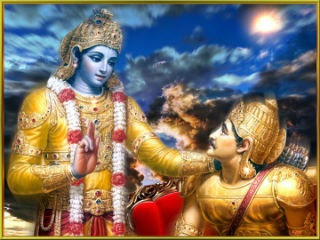
My primordial Nature, know as great Brahma, is the womb of all creatures; in that womb I place the seed of life. The creation of all beings follow from the union of matter and spirit, O Arjuna. (Gita 14/3)
Sarvayonishu kaunteya moortayah sambhavanti yaah |
Taasaam brahma mahdhyoniraham bejampradah pitaa ||
(Gita 14/4)
O' Son of Kunti! Of all the bodies that take birth from different wombs, this primordial Matter (prakriti) is the Mother, while I am the seed giving father.
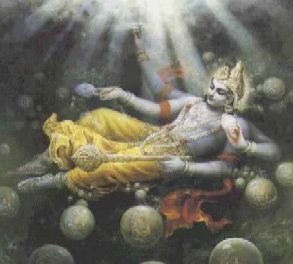
That Lord is the eternal seed of the entire Universe. God says -
Yacchaapi sarvabhootaanaam beejam tadahamarjuna |
Na tadasti vinaa yatsyaanmayaa bhootam charaacharam ||
(Gita 10/39)
O' Arjuna ! I am the seed (the main cause) of all beings. There is no creature, animate or inanimate, that can exist without Me. (Gita 10/39)
In other words, animate – inanimate all are God only.
In this world a seed is born out of a tree or plant but God is unborn. Therefore God has used the words - an “eternal seed” -
Bijam maam sarvabhootaanaam viddhi paarth sanaatanam
(Gita 7/10)
"O' Partha, know Me as the eternal (Sanatana) seed of all beings; (Gita 7/10)
Worldly seed gives birth to a plant and itself perishes, but God gives birth to infinite universes and remains the same as it is. Therefore God calls Himself “Eternal Seed” -
Prabhavah pralayah sthaanam nidhaanam beejamavyayam | (Gita 9/18)
"I am the origin, end, resting place, storehouse and the imperishable seed of this Universe."
The point is that God is there in the beginning of the entire Universe and at the end. It is a principle that, the thing which is there at the beginning and at the end, is also there in the middle (present). Just as various things are created out of soil (mother earth) , they remain in soil and in the end they merge into the soil. In the same way, all the seeds that are found in this world, they have all come from God, they remain in God and in the end they merge into God. It means that worldly seeds are born and they perish, but the eternal seed in the form of God is there as it is, in the beginning, middle and end. Therefore at present it is God only in the form of this world. There is nothing besides God.
Question - The inert world that is visibly seen at present, made of the five elements, which comes into being and later perishes, how is one to understand this to be the imperishable form of God?
Answer - All the things that are born of a seed, they are all a form of that seed only. Just as the wheat fields are called wheat only. The farmer says the wheat crop has come out really good, see how the wheat are standing upright in the fields and the fields are covered with wheat crop. But a person living in the city, a businessman, how can he regard the fields to be wheat? He will say I have purchased tons and tons of wheat and have sold it in the market, do I not know what the wheat looks like? This here is only grass, stems and leaves, not wheat. However, he who is a farmer, he only will say that this is not grass which is eaten by cows etc. This is wheat. If the cows eats from the fields, then they will say that the cow has eaten our wheat, even though the cow has not eaten a single grain of wheat. Even if there is not a single grain of wheat, then too it is wheat only. There is no doubt about this. Because it was wheat in the beginning, it will be wheat in the end, then in the middle in the form of a field, it is wheat only. Right now it appears to be green grasslike, but later when it matures and ripen, wheat will be harvested. In the the same way, in this world, first there was God -
“Sadeva somyedamagra aaseedekmevaaditeeyam”
(Chandogya. 6/2/1),
and in the end too, only God will remain -
“Shishyate shesasangyah”
(Srimad Bhagavata 10/3/25).
Therefore in the middle too everything is only God -
“Vasudevah Sarvam” (Gita 7/19),
“Sadasacchaham” (Gita 9/19).
The entire universe manifests from God, i.e. besides God there is nothing else at all. That which comes in one’s imagination and that which is beyond one’s imagination, it is all in all a form of God. In waking and in dream state whatever is seen, it is all only God. Real is also God, unreal is also God, and that which is beyond the real-unreal is also only God.
“Sadsattparam yat” (Gita 11/37).
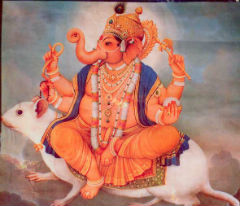
That Brahmin whose feet were held by the Lord and placed on His heart, such a dear one, as well as, the lowliest of lowly ones - both are a form of God. Just as one prostrates before Ganeshji made of gold, but does not prostrate before a mouse made of gold, but in the eyes of the goldsmith, they are both worth the same; in the same way, a Brahmin and a lowly one, a sadhu and a butcher, a cow and a dog, an elephant and an ant, a heap of soil and gold are all different in terms of class, quality, duty etc., but from the perspective of devotion, they are the same, i.e. they are all a form of God - “Vasudevah Sarvam”. The point is that just as the various limbs of the body perform their functions, yet the effort to remove the pain and suffering of any one part is the same. In the same way - “Jaisa deva, waisi puja” From the perspective of “As is the god, so is the worship” accordingly even though relating with a Brahmin and a lowly “chandaal” etc. as per the dictates of the scriptures, there is no difference in the eyes of a devotee (seeing the Lord equally in all), and there is no difference when it comes to making an effort to remove their suffering and in giving them comfort.
All the changes that are seen in the world, they are all a glimpse of the Lord, a tinge of His glory, a glance at His perkiness, His divine play. When a worldly man gets a glimpse of this, he becomes entangled. Due to a sense of enjoyment, his sight gets stuck in the ever-changing world. It does not reach God. With the influence of “satsang” he becomes disinclined towards the world i.e. turns away from the world, and becomes inclined (turns) towards God, then out of His immense grace, God graces Him with dualistic devotion i.e. The Lord blesses him with divine feelings and sentiments.
Everything is only God - There is no spiritual discipline as great as this, there is no devotion and worship like it. With such feelings and sentiments, God Realization becomes very easy. While giving the discourse on seeing “All is God”, Brahmaji said -
Ahamevaasmevaagre naanyad yat sadsat param |
Paschaadaham yadetacch yovashishyet sosmyaham ||
(Srimad Bhagwat. 2/9/32)
“Before creation, only I was present. Apart from Me, there was nothing else, and after the creation of this world, whatever is seen is Me alone, all that is existent (real, sat) and non-existent (unreal, asat) and beyond the two, in all of this, there is only Me, and after dissolution of this Universe also, there is only Me, and whatever remains after destruction that too is Me alone.”
Even in Gita, the Lord has said -
Ahamaadisch madhyam cha bhootaanaamant eva cha || (Gita 10/20)
“I am the beginning, the middle and also the end of all creation.”
Sargaabaanaadiranyascha madhyaam chaivaahamarjuna (Gita 10/32)
O’ Arjuna! I am the beginning, the end and also the middle of all creation.
In this manner, to recognize the Universe that came into existence from God is knowledge. As long as one sees their existence as separate and independent from the world, till then, it is ignorance. Just as seeing the wheat fields as wheat is knowledge, and seeing it as nothing but stalks or grass is ignorance.
Question - From wheat, only wheat can be produced, from millets, only millets can be produced, then how are these various creatures both movable and immovable produced from God?
Answer - Wheat, millet etc. are grains (seeds, beej) in this world, but God is extra-ordinary and transcendental (eternal and indestructible) seed. Therefore from the One God, various universes come into being. The three plains (lok), the fourteen universes (bhuvans), the inert-sentient, movable-immovable, creatures on land, water and skies, born from egg, womb, seed, among the three modes of nature - mode of purity, activity or inertia, man, demi-god, ancestors, heavenly minstrel, animal, bird, insect, ghost-evil spirit-demon, devil etc, all are from the fields of that extra-ordinary seed! In Gita, the Lord says -
Matah paratam naanyatkinchidasti
(Gita 7/7)
"There is no one else besides Me in this world, not in the least bit (both the cause and the act of doing).
"ye chaiva saatvikaa bhaavaa raajasaastaamasaascha ye
Matta eveti taanviddhi na tvaham teshu te mayi"
(Gita 7/12)
Whatever entities there are, born of Sattva (the quality of goodness), and those that are born of Raajasa (the principle of activity) and Taamasa (the principle of inertia), know them all as evolved from Me alone. In reality, however, neither I exist in them, nor do they exist in Me."
Bhavanti bhaavaa bhootaanaam, matta eva pruthagvidhaah ||
(Gita 10/5)
“Various and diverse traits in all beings emanate from Me alone.”
Matah smrutirgyaanamapohanam cha |
(Gita 15/15)
I am the source of memory, knowledge and the reasoning faculty. (Skepticism and all evil tendencies are destroyed by Me alone).
In Srimad Bhagavata, God says -
Manasa vachasa drshtvaa
gruhyatenyairpeeindriyaih |
Ahameva na mattonyaditi budhyadhvamanjasaa ||
(Srimad Bhagavat 11/13/24)
Through the mind, speech, and other senses, whatever is perceived, all that is Me and beyond Me there is nothing else – you should quickly understand i.e. accept this doctrine.
The meaning is that whatever sentiments, actions, objects born of purity, activity and inertia that are taken in by the body-senses-mind-intellect, they are all only God. All the thought waves / propensities (sphurna) of the mind, whether they are good, or bad, are God only. In this world whatever is good-bad, pure-impure, friend-foe, evil-doer or gentleman, sinful-virtuous, our own or not, etc. , whatever is seen, heard, spoken, thought, understood, etc., it is all only God. Body-indweller, field-knower of field, lower-higher nature, perishable-imperishable - it is all God only. There is nothing else besides God -
“Mayya tadmidam sarvam” (Gita 9/4).
"All this world is pervaded by Me in My unmanifest form". When everything is only God, then where did “I” (individuality) come from? There is no “I”, there is only You and You alone -
"Tu Tu kartaa Tu bhayaa, mujhmein rahi na Hun |
Vaari pheeri bali gai, jita dekhu tita Tu ||"
"Uttering Thou, Thou, I was transformed into Thou and there remained no sense of I-ness in me; I have surrendered myself to Thee and so wherever I see, I see Thee alone."
From the perspective of a Jnāni, Gītā has said that -
"gunaa guneshu vartante" (Gita 3/28).
In other words, it is all an interplay of modes of nature. Similarly, from the perspective of devotion, God’s things are offered to God. Just as someone prays to Gangaji by offering Gangajal (water from Gangaji), prays to the Sun by lighting a “deepak” (lamp), offers flowers grown on earth to the earth in prayer, in the same way, with God’s things, we worship God ! As such if it is seen, then the one to be revered is also God, the things used in prayer are also God, the prayer is also God and the one praying is also God! God says -
Aham kraturaham yajnah svadhaahamahamausadham
Mantro'hamahamevaajyamahamagniraham hutam
I am the Vedic ritual, I am the sacrifice, I am the offering to the departed, I am the healing (medicinal) herb, I am the Sacred formula (Mantra), I am the clarified butter, I am fire, I am the act of offering oblations into fire. I am the object of knowledge, the purifier, the sacred syllable OM, and the three Vedas - Rig, Sama, Yajur.
"Brahmaarpanam brahma havirbrahmaagnau brahmanaa hutam
brahmaiva tena gantavyam brahmakarmasamaadhinaa." (Gita 4:24)
" The act of offering is God, the oblation is God. It is offered by God, into the Fire of God. God is verily to be attained by him who is absorbed in God in the act of such sacrifice (yagna) " (Gita 4:24).
In this manner, by seeing God everywhere, the likes-dislikes (attraction-aversion) do not remain in the least bit, in an aspirant. The reason being that when everything is only God, then who will like or dislike and to whom?
Uma je Ram charan rat bigat kaam mad krodh |
Nij Prabhumai dekhahin jagat kehi san karahin birodh ||
(Manas, Utter. 112 Kha)
There is one exceptional point that to experience that “All is only God” - one does not need to do anything, nor does one need things (objects), rather one needs discriminative faculty (vivek) and feeling and sentiments (bhaav). There is quest to know in “vivek”, and in feelings and sentiments, there is acceptance (belief). Both discrimination and sentiments in the end merge into knowledge of Truth. In the path of knowledge, there is predominance of discrimination (vivek), and in the Path of Devotion (Bhakti marg), there is predominance of feelings and sentiments of the very existence of God. In the path of knowledge (jnana marg), first one knows, then one believes, and in the path of devotion, first one believes and then one knows. The end result of both is one and the same. It means that the outcome of knowing the Essence, the Truths, and the outcome of unflinching belief, is the same. In the path of devotion first the devotee accepts unflinchingly that “everything is only God”, then he attains realization of the Truth, that is he realizes, that “Everything is only God”.
From the perspective of Jnanayog all modes (purity-passion-inertia) are born of Nature -
"Sattva rajastvam iti gunah prakrtisambhavaah
Nibadhnanti mahaabaaho dehe dehinamavyayam."
(Gita 14:5)
Sattva, rajas, tamas - these gunas (modes) born of nature (prakriti) bind the
imperishable spirit to the body, O Mighty-armed. (Gita 14:5) and,
From the perspective of discipline of devotion (bhakti yog), all modes of nature are are manifestation of God -
"ye chaiva saatvikaa bhaavaa raajasaastaamasaascha ye
Matta eveti taanviddhi na tvaham teshu te mayi" (Gita 7/12)
“Whatever entities that exist, those that are born of Sattva (the quality of goodness), and those that are born of Raajasa (the principle of activity) and those born of Taamasa (the principle of inertia), know them all as evolved from Me alone. In reality, however, neither I exist in them, nor do they exist in me."
Therefore from the perspective of a Jnana yogi, whatever is seen, it is all in Nature, which is constantly changing, it is an interplay of modes. From the perspective of a Bhaktiyogi, whatever is seen, is all a form of God and everything that is changing, is God’s divine play.
The world is neither in the view of the liberated, realized, or great soul who is a loving devotee of the Lord, nor is it in the view of God. He who has any remaining worldly desires, i.e. he who has given significance to the world, from his perspective, the world is existent - "yayedam dhaaryate jagat" (Gita 7/5) - By which the whole universe is sustained" (Gita 7/5) This desire for the world is itself the cause of the “seed” bondage in the form of birth and death -
Vaasana yasya yatra syaat sa tam svapreshu paschyati |
Swapravanmaarane geyam vaasanaa tu vapurnrunaam ||
“Wherever a man’s desire lies, he sees dreams accordingly. As is the dream, so is the death i.e. according to one’s “vaasanas” (desires and tendencies), the last thoughts will be, and according to the last thoughts, man’s tenor will be.”
These “vasanas” (desirous tendencies) have been called by Gita as “Gunasang” -
"kaaranam gunasangosya sadasadyonijanmasu |
(Gita 13/21)
"Attachment to the modes becomes the cause of its birth, in good and evil bodies." (Gita 13/21)
If there are no desires than one will realize the non-entity of the embodied soul (jeev) and the world and the existence of God - Vasudeva Sarvam (All is God).
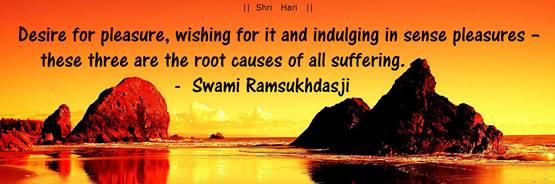
In the Path of Knowledge, through discrimination, an aspirant becomes detached from the world and in the Path of Devotion, an aspirant through faith (and sentiments) sees the world as a manifestation (form) of God. Everything is only God - is not the subject of discrimination (thought), rather it is the subject of faith (sentiments). Therefore “Everything is only God” - comes in the words of devotees.
As long as real and unreal, Brahma and World - these two remain, till then discrimination (vivek) will remain. When the belief pertaining to the unreal, the world, is wiped out, no more discrimination will remain, rather only enlightenment will remain. Therefore, through discrimination, by detaching from the world, and then seeing God, the existence of the world will remain, because, one only rejects, that which was believed to be existent. However, if through “Bhaav” (feelings and sentiments), if the world is seen as a manifestation of God, the world will not have an independent existence. As long as in the eyes of an aspirant, if God and the world are two separate, till then in his life there will not remain uninterrupted bliss, rather there is bliss at times and sometimes lack of relish. Sometimes an aspirant sees significant gains in their spiritual practice, and sometimes he sees no gains whatsoever. Therefore the best of all spiritual practices is the one in which an aspirant sees the world as a form of God (Bhagwat swaroop). i.e. he sees that it is God only in the form of the World.
Everything in only God - to experience this, an aspirant must accept with a firm conviction that whether I am able to understand or not, whether I am able to experience (realize) or not, but this is the Truth. Even if he sees the biggest or the smallest of all things, he must accept, that in this God is entirely present. Just as the water element is entirely present in both a drop of water and in the entire ocean. In the same way, in a pile of dirt or in all the earth all over this world, God is entirely present - “anoraniyaanmahato mahiyaan” (Katho. 1/2/20, Shvetaa. 3/20). On believing so, at all times, within one’s mind one must prostrate to all.* By doing so, he begins to see God everywhere. If you see from one perspective, then in the path of knowledge there is sentiments of duality (dvait bhaav) and in the path of devotion there is sentiments of monism (advait bhaav). The reason being in the path of knowledge, there is differences between, Nature and Man, Real and Unreal, Brahma and World, Eternal and Temporary, inert and sentient, body and indweller, field and the knower of the field etc. But in the path of devotion, besides God there is none other. In the path of Knowledge, Brahm is real and the World is Unreal - “Brahm Satyam, Jagatmithyaa”, but in the path of Devotion, both the real and unreal, and everything is God only - “Sadasacchahamarjuna” (Gita 9/19). Therefore “Everything is only God” - accepting so, he who takes refuge in God, i.e. who wipes out his independent existence (I-ness), and becomes merged into God, God calls him a “Jnani” - “Vasudeva Sarvamiti Gyaanvaanmaam prapadyate” (Gita 7/19). Such a “jnaani” devotee, is extremely dear to God. - “Priyo hi gyaaninotyarthamaham sa cha mama priyah” (Gita 7/17) and God calls him, His very own “swaroop” - “Jnaani tvaatmaiva me matam” (Gita 7/18). The point is that, “bhaav” sentiments are even more powerful than “vivek” (discrimination). Therefore, with “bhaav” utmost feelings and sentiments seeing the world as a manifestation of God is the best of all spiritual disciplines.
Footnotes -
* वायुर्यमोऽग्निर्वरुणः शशाङ्कः प्रजापतिस्त्वं प्रपितामहश्च ।
नमो नमस्तेऽस्तु सहस्रकृत्वः पुनश्च भूयोऽपि नमो नमस्ते ॥
नमः पुरस्तादथ पृष्ठतस्ते नमोऽस्तु ते सर्वत एवसर्व ।
अनन्तवीर्यामितविक्रमस्त्वं सर्वं समाप्नोषि ततोऽसि सर्वः ॥
(गीता ११/३९-४०)
"Vaayurmognirvarunah Shashaank prajaapatistvam prapitaamahasch |
Namo namastestu sahastradutvah, Punasch bhooyopi namo Namaste || (Gita 11/39)
You are the God of wind, God of death (yama), God of fire and water, the
moon-god, Prajapati and the great grandfather of beings, Salutations to You,
salutations a thousand time and again salutations to You. (Gita 11/39)
Namah purastaadath prushtste, Namostu te sarvat eva sarva |
Anantaveeryaamitavikramastvam, sarvam samaapnoshi tatosi sarvah ||
"O' Lord of infinite prowess, my salutations to You from the front, the rear and
from all sides. O' All in all ! You who possess limitless might, and pervade
the world, You are omnipresent. (Gita 11/40) You are everything My Lord !
खं वायुमग्निं सलिलं महीं च ज्योतिंषि सत्त्वानि दिशो द्रुमादीन् ।
सरित्समुद्रांश्च हरेः शरीरं यत् किञ्च भूतं प्रणमेदनन्यः ॥ (श्रीमद्भा॰ ११/२/४१)
"kham vaayumagnim salilam mahim cha |
jyotimshi satvaani disho dumaadeen ||
Saritsamudraanscha hareh shariram |
Yat kinch bhootam pranamedanayah ||
(Srimad Bhagwat 11/2/41)
"Space, wind, fire, water, earth, stars-planets, creatures-insects, trees, rivers, ocean – all-in-all is the body of God - accepting so, a devotee prostrates in front of all with undivided and exclusive feelings.
विसृज्य स्मयमानान् स्वान् दृशं व्रिडां च दैहिकीम् ।
प्रणमेद् दण्डवद् भूमावाश्वचाण्डालगोखरम् ॥
(श्रीमद्भा॰ ११/२९/१६)
Visrajya swayamaanaan svaan drsham vreedaam cha daihikeem |
Pranamed dandvad bhoomaavaashvachaandaalagosharam ||
(Srimad Bhagwat 11/29/16)
"If our own people laugh then let them do so, do not be concerned about that,
rather the shame that one feels with their body, leave that as well, prostrate
laying flat on the ground in front of a dog, a beggar, a cow and a donkey.
Goswami Tulasidasji says -
जड़ चेतन जग जीव जत सकल राममय जानि ।
बंदउँ सब के पद कमल सदा जोरि जुग पानि ॥
(मानस, बाल॰ ७ ग)
Jada chetan jaga jeev jat sakal raamamai jaani |
bandaun sab ke pad kamal sadaa jori jug paani ||
(Manas. Bala. 7 Ga)
आकर चारि लाख चौरासी । जाति जीव जल थल नभ बासी ॥
सीय राममय सब जग जानी । करउँ प्रनाम जोरि जुग पानी ॥
(मानस, बाल॰ ८/१)
Aakar chaari laakh chouraasi | Jaati jeev jal thal nabh baasi || Siya Rama maya sab jagah jaani |
Karaun pranaam jori jug paani || (Manas, Baalkand 8/1)
The meaning of saying “Siya-Ramamai” is that both male and female form, all the creatures and objects are a manifestation of “Sita-Ram”. Whether you say “Sita-Ram” aur “Radhe-Shyaam” or “Gauri-Shankar” or “Laksmi-Narayan” it is all one and the same.
Narayana ! Narayana !! Narayana !!!
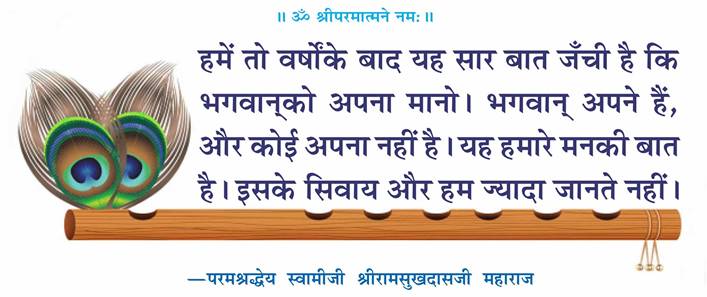
(From Book in Hindi "Bhagwaaan se Apnaapan" by Swami Ramsukhdasji
To read in HINDI visit - http://www.satcharcha.blogspot.com/
July 12, 2013
WEBSITES:
ENGLISH: www.swamiramsukhdasji.net
HINDI: www.swamiramsukhdasji.org
http://www.shriswamiramsukhdasjimaharaj.com/
http://www.sadhaksanjivani.com/
ENGLISH BLOG:
http://www.bolharibol.blogspot.com/
FACEBOOK: https://www.facebook.com/Swami-Ramsukhdasji-in-English-509217239256199/
GROUPS
https://groups.yahoo.com/neo/groups/sadhaka/info
https://groups.google.com/forum/#!forum/sadhak_insight
OTHER
Contact:
sadhak@swamiramsukhdasji.net