|| Shri Hari ||
Bhakti (Devotion) a Divine Spiritual Discipline

Swami Ramsukhdas
|| Shri Hari ||
Bhakti (Devotion) a Divine Spiritual Discipline
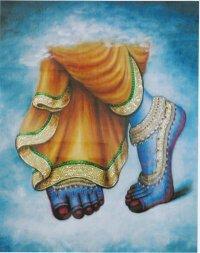
tvameva mata cha pita tvameva
tvameva bandhuscha sakha tvameva |
tvameva vidyaa dravinam tvameva
tvameva sarvam mama devadeva ||
Swami Ramsukhdas
|| Shri Hari ||
Bhakti (Devotion) a Divine Spiritual Discipline
There are three main spiritual disciplines for severing relationship with the world, and in attaining God -
●
Karmayog (path of action),
●
Jnanayog (path of knowledge), and
●
Bhaktiyog (path of devotion and faith).
In the Bhagwat, God says ‒
योगास्त्रयो मया प्रोक्त
नृणां श्रेयोविधित्सया ।
ज्ञानं कर्म च भक्तिश्च नोपायोऽन्योऽस्ति कुत्रचित् ॥
(श्रीमद्भा॰ ११ । २० । ६)
‘For those who desire their salvation, I have shared the three paths of yoga - Jnanayog, Karmayog and Bhaktiyog* Besides these three, there is no other path to salvation.’
________________________________________________
* In Gita the Lord has given His discourse in the following order - Jnanayog, Karmayog and Bhaktiyog
In Karmayog and Jnanayog, predominantly one severs relationship with the world and in Bhaktiyog, predominantly one establishes a relationship with God. Therefore Karmayog and Jnanayog are spiritual discipline of this world. Whereas Bhaktiyog is a transcendental spiritual discipline. Spiritual practices of this world are of ‘vivek maarg’ ( the path of discrimination), and transcendental spiritual practice is of ‘vishwaas maarg’ (the path of faith). Discrimination is primary and faith-trust are ancillary in the path of ‘vivek’ and in the path of faith, faith and trust are primary and discrimination is ancillary. In severing relationship with the world, discrimination is useful, and in establishing a relationship with God, faith is useful. An aspirant often makes the mistake that he blends discrimination with faith and faith with discrimination, in other words, in the path of discrimination, he makes faith the primary and in the path of faith, he makes discrimination, the primary. Due to this, his spiritual practices do not reach perfection quickly. It is not a matter of faith to have or not have an affinity with the world, rather one has to apply their ‘vivek’ (power of discrimination). And one is not to apply their ‘vivek’ (power of discrimination) in whether there is God or not, and whether He is ours or not ‒ rather, in this, one is to simply have faith. The reason being, the world and beings are subject of thoughts, and God is only a subject of faith. (belief).
Discrimination (thought) only applies, where there is some doubt, and doubt arises where there is scanty knowledge or incomplete knowledge. It means that on those topics where we have partial knowledge, i.e. we know a little and don’t know a little, there only 'vivek' (discrimination) will work. However, when we have no knowledge whatsoever of a particular subject, there, only faith will work. In faith there is no doubt whatsoever. All are independent in having faith (belief) or not having faith. *
A man of wisdom (jnaani) renounces his assumed relationship and affinity with the world and a devotee does not regard his relationship with anyone else besides God. In other words, a 'jnaani’ renounces relationship with 'me' and 'mine', and a devotee accepts 'you' and 'yours'. Therefore a 'jnaani' renounces objects and actions, and a devotee offers (turns over) objects and actions to God (Gita 9/26-27), in other words, he does not consider these as his own, rather he regards these as God’s and a form of God.
Taking refuge is easy, as compared to renunciation. The reason being, that it is far more easier to offer a thing to someone, and to apply it in their service, than to consider it as illusory (false) and renouncing the thing that man holds as real and significant. Then what to speak of the ease of offering to God, Who is an embodiment of faith, an embodiment of Love !
_________________________________________________
* In Vedas, Puranas and various other holy texts, and through the devotees of God or when so sorrow comes in a person’s life and one develops faith in God. When from difficulties arise, and there appears to be no way to be saved from these troubles, when there appears to be no resort, no support, no one to lean on, and all efforts to be saved from these have failed, then man has no choice but to have faith in God ! Man has to call out to the Lord !
As from the very beginning, all the things (inclusive of this entire universe) were belonging to God. To offer it to God, is only about rectifying your mistake. The moment you regard the world as God’s, you sever relationship with it. Therefore in order to sever relationship with the world, a devotee does not need ‘vivek’ (power of discrimination). It means, a devotee does not sever relationship with the world, rather he regards it as belonging to God and a manifestation of God.
‘Vivek’ (Power of discrimination) is useful for both spiritual and worldly matters. By applying ‘vivek’ (power of discrimination) in worldly matters, man can become a great scholar, a judge, a lawyer, etc. He can do various kinds of inventions and discoveries, but he cannot attain enlightenment. The reason being, that in worldly matters, along with ‘vivek’ (power of discrimination), there is 'raag’ (attraction), which increases the importance of sense enjoyment and hoarding, and it entangles man in the world, thus engaging man in sins, and making him take a fall.
It
means that, when the world is perceived as real and it is given due
importance, the ‘vivek’ (power of discrimination) can prove to be very harmful and
it promotes useless activity. In
reality, ‘vivek’ (power of discrimination) in worldly matters, is itself 'avivek'
(lack of power of discrimination).
‘Vivek’ (Power of discrimination) on spiritual matters, that is, discrimination between real-unreal
is itself genuine ‘vivek’.* When
there is ‘vivek’ discrimination
between real and unreal, both spiritual and worldly work takes place properly,
because the intellect of a man with ‘vivek’ (power of discrimination), enters
every subject area.
A man with spiritual discrimination, is also able to utilize worldly things properly. But a man with only worldly discrimination, he cannot even utilize the worldly things properly ‒
उपभोक्तुं न शक्नोति श्रियं प्राप्यापि मानवः ।
आकण्ठजलमग्नोऽपि श्वा लेढीति स्वजिह्वया ॥
सुभाषित क्र.१६७
‘Even on acquiring wealth that was destined to come, a man without discrimination cannot use it properly; just as a dog who is immersed in water up to the throat, still continues to lick the water with his tongue (he does not know how to drink water directly (i.e without licking).’
_________________________________________________
* प्रवृत्तिं च निवृत्तिं च कार्याकार्ये भयाभये ।
बन्धं मोक्षं च या वेत्ति बुद्धिः सा पार्थ सात्त्विकी ॥ (गीता १८ । ३०)
pravṛttiṁ ca nivṛttiṁ ca
kāryākārye bhayābhaye
bandhaṁ mokṣaṁ ca yā vetti buddhiḥ sā pārtha sāttvikī
O Pārtha (Arjuna), the intellect (Buddhi) which duly knows of the path of action and renunciation, of what ought to be done and what ought not to be done, of fear and fearlessness, of bondage and liberation - that intellect, is Sāttvika (of the nature of goodness).
Real discrimination is the progenitor of detachment. If there is no detachment, then real (natural) power of discrimination is not present. ‘I have no relationship with the unreal’. With this power of discrimination, one becomes detached with certainty.
In ‘vivek’ there are two things - real and unreal, therefore even on developing detachment, subtle impressions of the unreal remain in the inner-senses, thus subtle desires remain. These desires can only go away with Love and Devotion ‒
प्रेम भगति जल बिनु रघुराई ।
अभिअंतर मल कबहुँ न जाई ॥
(मानस, उत्तर॰ ४९ । ३)
prema bhagati jala binu raghuraai ।
abiamtara mala kabahun na jaayi ॥
(Manas, Uttar॰ 49 । 3)
Except by cleansing with the water of loving devotion, O’ Lord of the Raghus, the impurity accumulated within can never be washed away.
The power to totally destroy that subtle desire lies only in Love. In love, without any thought, the attraction for the unreal goes away on its own; because when there is love in the ‘Sat’ (Imperishable, Real, God, Existent element), the sight does not go towards the unreal (temporary). There is total distancing of one’s self from the unreal ‒
‘सपनेहुँ आन पुरुष जग नाहीं’
(मानस, अरण्य॰ ५ । ६)
Sapanehun aana purusha jaga naahim
(Manas, Aranya. 5 / 6)
A woman of the best type is convinced in her heart of hearts that she cannot even dream in this world of a man other than her Lord.
It means that Love is not two, rather it is the one God only. Therefore ‘vivek’ remains neutral and impartial, but Love connects with God. Only when there is greed, one can attract with money. Similarly, only love has the power to attract one to God. This power is not in ‘vivek’ (power of discrimination). Yes, but if there is an intense quest to know, then even in ‘vivek’ (power of discrimination), the predominance can be of the 'sat' (God, truth, existent element). With predominance of ‘sat’ (real, existent element), ‘vivek’ not only becomes the father of detachment, rather it also becomes the receiver of ‘tattva bodh’ (enlightenment).
In the path of discrimination, when there is belief in both the real and unreal at the same time, the very subtle existence of the unreal, i.e. the very subtle ego persist for a long time. This subtle ego, remains even after liberation. This subtle ego, is not the kind to give birth and death, but it is an obstacle in bringing about a sense of oneness (inseparability) with God. Therefore in the path of discrimination, the man of wisdom or the philosopher can attain liberation, but he cannot experience the oneness, the inseparability with God. In other words, he cannot experience Love. Due to this very subtle ego, there is differences among the various philosophers and their philosophy.
In the path of belief, from the very beginning, the devotee does not accept the independent existence of any other entity, apart from God. Therefore he becomes inseparable from Paramatma (God). On becoming one with Paramatma, the subtle ego does not remain, and all the differences that arise due to subtle ego, come to an end. Therefore, the oneness in ‘jnana’ (Knowledge), the oneness experienced in love is superior. The reason being that in knowledge there are differences, but in love, no differences remain.
In the path of discrimination, there are two types of spiritual practices - ‘vidhyaatmak’ (through knowledge) and ‘nishedhaatmak’ (through negating). In the spiritual practice based on knowledge, a subtle egoism remains. Because in this spiritual practices, study and knowledge are main, therefore there remains reliance on the ‘asat’ (unreal). In this the aspirant thinks that I need to be established in the ‘sat’ (real, existent). When this thought prevails, then even on severing relationship with the ‘asat’ (unreal), the one that is established in the ‘sat’ (real) remains. ‒ this itself is subtle egoism. This subtle egoism, does not allow unity among the various philosophers. Due to there being differences of opinion among the philosophers, there remains differences in the way they see things. In other words, they believe in God, according to their own opinions, that is part of the whole, not the whole. They do not know That Universal form of God, where there are no differences of opinion.
From the perspective of the various philosophers, their own philosophical opinions are provable, though in fact, it is not provable, but are the essence of spiritual practice. Spiritual practices may be various, but the essence of spiritual practices is one.
In fact, in the goal (Universal form of God), there is no differences of opinion among all the philosophers. But due to there being subtle egoism, the various philosophers feel that their own school of thought (path) is superior. Other’s schools of thought are not so good, not so beneficial, and they are also of the belief that without knowledge one cannot attain liberation; Or without selfless service, one cannot be liberated; Or without devotion and love, one cannot be liberated. Therefore they praise their own belief systems and refute other’s belief systems. They do not refute others belief system looking upon them negatively, rather with a pure vision, they propagate their belief systems, with the intent of other’s salvation, so that people do not become adversary and they attain their own salvation. The reason being, they themselves have experienced and have no doubts about it that they have attained peace. Therefore it is proper for them to be saying so. However, due to pride of their body, the followers of their belief systems, remain insistent on their own beliefs. Due to the insistence in their own belief system, they criticize other’s beliefs, instead of pursuing their own beliefs, and they have hatred towards other people with different belief systems. By following other beliefs also one can attain salvation. However, they are in total disagreement with the thought that - one can attain salvation by following other belief systems ! On the contrary they regard the other belief systems as a fallacy. They are of the belief that others will have to come to our belief system, and then only they will attain benediction ! The aversion that they have towards others, and their belief systems, is stronger and more horrendous than the ordinary worldly likes and dislikes. Due to this aversion they want to destroy other’s belief systems once and for all ! In this manner, the fights are not among the philosophers themselves, rather it is among their followers.
It is not wrong to have a sense of gratitude, feeling great about one’s spiritual practice, but to criticize other’s belief systems is wrong. Therefore an aspirant must do his spiritual practices as per his belief, without criticizing other’s beliefs and without insisting on his own belief system. At the most he can say that I do not know that system ! There is nothing wrong in acknowledging one’s ignorance, however it is wrong to tell others about your good qualities. By sharing one’s imperfections (ignorance), one perceives perfection in others while sharing our good qualities, we see flaws in others. Therefore an aspirant should never regard himself as an accomplished perfected spiritual aspirant, rather he should always consider himself to be a ‘sadhak’ (aspirant). By assuming super-natural powers, perfection, a sadhak’s further spiritual progress will be stalled, and he will be betrayed, i.e. if there is something lacking in him, it will continue to persist.
Question ‒ Even after liberation, the subtle ego remains ?
Answer ‒ Even on attaining liberation, there is subtle egoism remaining in a Jnaani (philosopher), due to which there is mutual separation, apartness, differences between them. This subtle egoism is in fact the impression of egoism, which is the cause of birth and death. Association with the modes of nature is the cause of birth and death ‒
‘कारणं गुणसंगोऽस्य सदसद्योनिजन्मसु’ (गीता १३ । २१)
Meaning: Attachment to the Gunas becomes the cause of its birth in good and evil wombs. (Gita 13/21)
The association with a path is not a cause of birth and death. Association with a path means that the path by which one attained perfection (liberation), the impressions of that path, is called ‘subtle egoism’.
In subtle
ego, the self not developing affinity
with the world, remains inclined towards the
Parmatma-tattva (God). This subtle
ego resides in the solidarity of knowledge, not in the solidarity of Love. The reason being, that the devotee does not
have his own allegiance, rather he is
steadfast on God; but a 'jnaani' has
his own steadfastness. Therefore in
devotion, the ego changes, and becomes
merged in God, by which the impression
of that I-ness are wiped out. Yes, but
on having reached great heights, then
even the very subtle ego of a Jnaani
goes away.
Differences remain in knowledge, not in Love. In Love one can attain the Universal form of God; because in the attainment ‘Vasudeva Sarvam’ ( Universality, All is God), love is the cause, not knowledge. There is one exceptional point that in the path of knowledge, liberation too comes from Love ! Because in the self (existent element) without love, attraction, one cannot get established in the self. The love that a Jnaani has for the self, that love will liberate him, but it is not a rule that it will let me realize the Universal form. The reason is that this love of the existent, is not like worldly infatuation and it is not at all the kind that leads to birth and death, but it is an obstacle in respecting all schools of thoughts equally, when in fact, the one doing the spiritual practices, turn away from the unreal, and those who turn towards the real are all respectable. Seen from a gross perspective, then a ‘jnaani’ does not become one with others, whereas a devotee becomes one with all. Because a ‘jnaani’ has pride in the beginning, and a devotee from the very beginning has humility, and is charitable. Yes, if a devotee has pride, then he cannot become one with others. Pride will be destroyed when ‘jnaani’ does not remain. Only knowledge remains. When lover does not remain, only love remains. In knowledge one attains ‘akhand’ (uninterrupted) bliss, but in devotion, one attains ‘anant’ (infinite) bliss. In uninterrupted bliss, the ‘jnaani’ remains ‘ekaaki’ (by himself), therefore he does not get satisfied with uninterrupted bliss, ‒‘एकाकी न रमते’ When there is lack of interest in uninterrupted bliss, then his longing for the infinite bliss, i.e. love that is every moment, increasing, is awakened.
The joy that is experienced by a liberated soul is also a sense enjoyment. It is only when that enjoyment leaves that one attains love. The joy in a liberated soul is that of parting, and the joy of love is one of union. For a lover, even liberation appears to be dry. God is also hungry for love, not of knowledge. Knowledge is that very self ‒
‘सच्चित्सुखैकवपुषः’,‘चिदानंदमय देह तुम्हारी’
(मानस, अयोध्या॰ २ । १२७ । ३) ।
‘Your body is all consciousness and bliss’
In reality, ‘Advaita’ is only in Love. In love, besides the one God, there is no other existence. None whatsoever. In Love, both the lover and the beloved though being one, are two, and though being two, are one.
A lover’s sentiments are not ignited towards others. That eye of love has never gone towards anyone else, is not, and will never go towards any one, it can never ever go; because in love there is absolute non-existence of any other. A lover only sees his beloved everywhere ‒ ‘जित देखौं तित स्याममयी है’
Therefore the divine form of Love has been called ‘Anivarchaniya’ ‘indescribable.’ ‒
अनिर्वचनीय प्रेमस्वरूपम् । मूकास्वादनवत् ।
(नारदभक्तिसूत्र ५१ । ५२)
As long as there is existence of the many, till then, it is only a spiritual discipline of Love and devotion, and not ‘Parabhakti’ (the Eternal Love of God). Therefore, in knowledge it is indescribable character and in love it is ‘indescribable form’. It means that in knowledge there is negation of the many and in love there is total non-existence of the many. The reason is that in Love, totality is the attainment of God, therefore a lover does not have animosity or opposition towards any one. In the Lover’s sight when everything is a limb of the totality, thus it is our Lord only, therefore who will have animosity, with whom and why ‒
‘निज प्रभुमय देखहिं जगत केहि सन करहिं बिरोध’ ?
Nija prabhumaya dekhahi jagata, kehi sana karahi birodh ?
(Manas, Utter. 112/B)
Meaning: Looking upon the entire world as full of their Lord; against whom can they harbour animosity?
For instance, some are lovers of Ram, some of Krishna, and some of Shiva, then too they all can mutually unite, but all men of knowledge, cannot unite. If a ‘jnaani’ (man of knowledge) and a loving devotee meet, then the extent to which the devotee will respect the man of knowledge, that much the ‘jnaani’ will not be able to respect the loving devotee. Therefore, the qualities of a devotee are said to be ‒ ‘सबहि मानप्रद आपु अमानी’
Sabahi maanaprada aapu amaanee |
(Manas, Uttar॰ 38 । 2)
Meaning: Giving honour to all, they are honest themselves.
In the beginning of the Ramayana, Goswami Tulasidasji Maharaj praises the evil-doers along with the good men and does so with a true heart ‒ ‘बहुरि बंदि खल गन सतिभाएँ ' (मानस, बाल॰ 4 / 1)
Bahuri Bamdi khala gana satibhaaen
(Manas, Bala. 4/1)
Meaning: Again, I greet with a sincere heart the malevolent class.
Only a devotee can do so, not a man of knowledge ! Although a man of knowledge has no animosity towards anyone, then too he has the qualities of indifference, impartiality and neutrality.
In
the path of discrimination (knowledge),
there remains a predominance of detachment, and this reclusiveness and detachment are
dry. Therefore even though ‘jnaani’ is not hard and fast within,
then too, due to detachment,
indifference, on the outside, he
appears to be harsh and abrasive.
The qualities of Karmayog are addressed in the Gita (2 । 55‒72,6 । 7‒9), qualities of a Jnaani (man of knowledge) are covered in the Gita (14 । 22‒25) and qualities of a Bhaktiyogi (devotee) are also listed in Gita (12 । 13/19), but it is only in the devotees' qualities and behavior that God says ‒
अद्वेष्टा सर्वभूतानां मैत्र: करुण एव च ।
Adveshta sarvabhootaanaam maitrah karuna eva cha (Gita 12/13)
Meaning: A devotee hates no being, and he is friendly and compassionate to all beings. (Gita 12/13).
The qualities ‘maitrah karuna’ (friendly and compassionate) have neither come in the qualities of a Karmayogi nor in that of a Jnaani, rather they have only come in the qualities of a devotee.
Both ‘jnaana’ (knowledge) and ‘vairaag’ (detachment) come on their own, in a devotee. A devotee does not have to try to cultivate these.* ___________________________________________________
* भक्तिः परेशानुभवो विरक्तिरन्यत्र चैष त्रिक एककालः ।
प्रपद्यमानस्य यथाश्नतः स्युस्तुष्टिः पुष्टिः दपायोऽनुघासम् ॥
इत्यच्युताङ्घ्रिं भजतोऽनुवृत्त्या भक्तिर्विरक्तिर्भगवतबोधः ।
भवन्ति वै भागवतस्य राजंस्ततः परां शान्तिमुपैति साक्षात् ॥
( श्रीमद्भा॰ ११ । २ । ४२-४३)
‘Just as a person who is eating his meal, with every morseful, he gets all three of these at the same time - satisfaction, nourishment and end of hunger, in the same way, when a man takes refuge in God, and begins to worship Him, and at every moment ‘bhajan’ he develops love for God, he experiences his beloved Lord’s form ‘swaroop’ and becomes detached from anything else besides the Lord ‒ all these three are attained at the same time. Rajan ! in this manner, he who at every moment, with each of his ‘vruttis’ worships the Lotus feet of the Lord, he attains devotion, detachment and realization of God. He most certainly attains these three, and he becomes divine and attain eternal peace. ’
The reason being, that knowledge and detachment are the sons of 'bhakti' (devotion and love) and wherever the mother goes, inevitably the sons go there as well ! In this there is one exceptional point that, the knowledge and detachment that comes in a devotee, is more special than the knowledge and detachment in a man of knowledge (jnaani). Just as in the path of knowledge, one gains knowledge of God without form and attributes, but in the path of devotion, one gets total knowledge, because God Himself gives knowledge to His devotees. †
______________________________________________
† तेषां सततयुक्तानां भजतां प्रीतिपूर्वकम् ।
ददामि बुद्धियोगं तं येन मामुपयान्ति ते ॥
तेषामेवानुकम्पार्थमहमज्ञानजं तमः ।
नाशयाम्यात्मभावस्थो ज्ञानदीपेन भास्वता ॥ (गीता १० । १०-११)
Teshaan satatayuktaanaam bhajataam preetipoorvakam
dadaami buddhiyogam tam yen maamupayaanti te ||
teshaamevaanukampaarthamahamgyaannajam tamah |
naashyaamyaatmabhaavastho gyaanadeepen bhaasvataa ||
(Gita 10/10-11)
'I give divine wisdom (equanimity) to those devotees of Mine, who are constantly dedicated to Me, with the help of which they attain Me.' (Gita 10/10)
'Such devotees, being part of My existence, receive My divine grace which destroys the darkness of ignorance with the help of light of Knowledge.' (Gita 10/11)
Just as, in the path of knowledge, even while the objects are present, there is detachment towards them, and the attraction in them goes away. But in the path of devotion, there is detachment, and the objects lose their independent existence and it becomes ‘bhagwatswaroop’ (an embodiment of the Lord) ‒
‘Vasudevah Sarvam’ (Gita 7/19)
’वासुदेवः सर्वम्’ (गीता ७ । १९),
‘Sadsacchahamajuna’ (9/19)
’सदसच्चाहमर्जुन’ (गीता ९ । १९)
The reason being ‘adhibhoot’ i.e. the entire universe is made of the five material elements and is a limb of the Universal God. ‒
‘साधिभूताधिदैवं मां साधियज्ञं च ये विदुः’ (गीता ७ । ३०)
Saadhi bhutaadhidaivam maam saadhi yagyam cha ye vidhuh |
Prayaanakaalepi cha maam te viduryuktachetasah || (Gita 7/ 30)
Those who realize Me in the Adhibhuta (the field of matter), in Adhidaiva (Brahma, The Infinite) and in Adhiyagna
(the unmanifest Divinity), and having a steadfast mind, realize Me, even at the
hour of death. (Gita 7/30)
Narayan ! Narayan !! Narayan !!!
From book in Hindi ‘ Sab Jagah Ishvar Roop’ by Swami Ramsukhdasji
MESSAGE IN HINDI AT :
http://www.satcharcha.blogspot.com/
Date : 21st April, 2014 onwards - Alaukik Saadhan - Bhakti
******************************************************************************
A Note to Readers
The special quality of the original is difficult to capture in a
translation. Readers are earnestly requested that if they have
the knowledge of the Hindi Language, to read the original works
in Hindi
******************************************************************************
WEBSITES:
ENGLISH: www.swamiramsukhdasji.net
HINDI: www.swamiramsukhdasji.org
http://www.shriswamiramsukhdasjimaharaj.com/
http://www.sadhaksanjivani.com/
BLOGS:
http://www.bolharibol.blogspot.com/
http://www.satcharcha.blogspot.com/
FACEBOOK:
https://www.facebook.com/Swami-Ramsukhdasji-in-English-509217239256199/
GROUPS
https://groups.yahoo.com/neo/groups/sadhaka/info
https://groups.google.com/forum/#!forum/sadhak_insight
OTHER
Contact:
sadhak@swamiramsukhdasji.net
