|| Shri Hari ||
For Spiritual Aspirants - Discourse 10

Swami Ramsukhdas
Shri Hari ||
For Spiritual Aspirants - Discourse 10
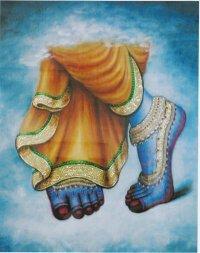
tvameva mata cha pita tvameva
tvameva bandhuscha sakha tvameva |
tvameva vidyaa dravinam tvameva
tvameva sarvam mama devadeva ||
Swami Ramsukhdas
|| Shri Hari ||
For Spiritual Aspirants - Discourse 10

Man’s supreme good is not dependent on any circumstance; rather it is dependent on the proper use of that circumstance. However unfavourable a situation comes, man can attain his supreme good in that itself. Man tries very hard to change his circumstances - that may this poverty go away, and may riches be showered upon him, may his ignorance be wiped out, and may he become knowledgeable, may the disease be eradicated, and may he become free of any disease etc. In this, a lot of his time is wasted. However, if man thinks of his own salvation, he will benefit significantly.
In this life, there is no situation or circumstance in which a man cannot attain his supreme good. The reason is that, in any situation or circumstance, God is not less or more, not close or far, rather in every circumstance, He is equally and consistently present. Therefore, in every circumstance, an aspirant can realize God. There is no obstacle in realizing God. Human birth has been bestowed for God-realization only, and situation and circumstance remain exactly the same for two people. Therefore, if God-realization takes place in one particular circumstance or condition, then all would have attained salvation ! This has not been said; rather it has been said that any one will attain salvation. Therefore, an aspirant should make proper use of his circumstance.
For proper use, first he must see whether the situation is favourable or unfavourable ? If it is unfavourable, then give up the desire for favourable. When there is desire for pleasurable (or favourable) situations, then unfavourable situations lead to sorrow. Therefore, if one renounces the desire for favourable situations, then unfavourable (sorrow-filled) situations will become the means to progress. Likewise, when favourable situations come, he should renounce desire for sense enjoyment and pleasures and the hope of these continuing; because, they are not the kind to stay at all. By not enjoying those pleasures, one should serve others through it. The reason is- favourable situations are only for serving others, not for one’s sense pleasures.
एहि तन कर फल बिषय न भाई ।
स्वर्गउ स्वल्प अंत दुखदाई ॥
(मानस ७ । ४३ । १)
"Ehin Tan Kar Phal Vishay Na Bhai,
Swargau swalpa ant dukhdaayi "
(Manas 7/44/1).
Meaning: O’ Brothers ! the reason for attaining this human body is not sense pleasures. What to speak of all the pleasures of this world, but even the pleasures of heaven is also very little and in the end it is the kind to lead to suffering.
‘Renounce’ (in other words means) that he is not to become an enjoyer of pleasures, and instead ‘serve’, i.e. to give joy to others. Both these are the kind to lead to supreme good, i.e salvation, which every man can attain. In renunciation, service takes place; and in service, there is renunciation.
Even in unfavourable circumstances, man can serve others by giving them happiness. If someone says, ‘I do not have any money, how can I make others happy !’; it isn’t so that one can give pleasure to others only with money. We have to have the bhav, the feelings (sentiments) in our heart to make the other person happy. If the other person is sad, we too must become sad from the heart, then how can his unfavourable situation go away ? Talk to him lovingly and listen. Tell him that when unfavourable situations come, he must not be afraid; such situations came to Lord Ram, Nal, Harishchandra etc. and to various other great men too; nowadays, many people are suffering even more than you are. If there is any work fit for me, then please tell me, and so on. By saying such things, he will be pleased. In the same way, by meeting a happy person, we should also become happy from the heart, that it is a wonderful thing, then he will be very pleased. In this manner, we can serve the happy as well as sad people. By concurring with other’s joy as well as sorrow, we can make them happy. Only the feeling of always seeing to other’s good in needed - sarvabhootahite rataah - He who becomes sad in other’s sorrow, and happy in other’s happiness is a Saint ‒
‘पर दुख दुख सुख सुख देखे पर’ (मानस ७ । ३७ । १) ।

A doubt may arise that we are already saddened by our sorrows, and if we begin to be saddened by other’s sorrows too, then we will be in the crying mode all the time ! Our sorrows will never come to an end; because, in this world, we will be meeting someone or the other who is suffering ! The explanation for this is - just as when sorrow comes to us, we try to get rid of it, in the same way, on seeing others suffering, we should aspire to get rid of their sorrows. We should have genuine feelings to get rid of their suffering. Therefore, the meaning of being saddened by other’s sorrow means that we should have the feelings, sentiments and the aspiration to see them free of sorrow, by which we will be joyful, not sad.
When one is saddened by other’s sorrow, then whatever power, abilities, things etc. he possesses, it is all automatically engaged in getting rid of other’s sorrows. To make an unhappy man happy is not in our hands, but to offer our things to him in order to rid him off his sorrows is certainly in our hands. In this manner, by renouncing, pleasures and other objects of enjoyment, instantly one attains peace ‒
‘त्यागाच्छान्तिरनन्तरम्’ (गीता १२ । १२)
“tyaagaacchaantiranantaram” (Gita 12/12)
Meaning : There is peace in renunciation (Gita 12/12)
In Patanjali Yogdarshan, it has come ‒
‘मैत्रीकरुणामुदि-तोपेक्षाणां सुखदुःखपुण्यापुण्यविषयाणां भावनातश्चि-त्तप्रसादनम् ।’ (१ । ३३)
Meaning : On being friendly with those who are happy, compassionate towards those who are suffering, joyful for those who are virtuous, and indifferent towards sinners, the mind is purified.
However, Gita has taken all these four points and shared them in two ‒
‒‘मैत्रः करुण एक च’(१२ । १३)
maitreha karuna evacha
Meaning : Who is friendly and compassionate to all.
It means - to become friendly on seeing the happy and virtuous ones, and to feel compassionate on seeing the suffering and sinners. There isn’t that much gain in indifference towards the sinners as there is in compassion. The inner senses become purified with friendliness and compassion. By feeling jealous for those who are happy and feeling pride on seeing the unhappy, the inner senses become tainted. The inner senses are tainted on aversion and hatred towards the sinners. Whatever situation, state, place, time, person etc. comes our way, it is all a means to God-realization. If man learns the knowledge of putting it to proper use, then his salvation is a certainty.
Whatever may be the situation-circumstance, one must put it to proper use. If one is unable to do this, then one must look in the Holy scriptures pertaining to the Truth, or ask the Saints and great souls, contemplate themselves, remember God and pray to Him, then the real wisdom will be illumined within. On conducting oneself according to this wisdom, one will attain his supreme good. Gita teaches us ‒
सुखदुःखे समे कृत्वा लाभालाभौ जयाजयौ ।
ततो युद्धाय युज्यस्व नैवं पापमवाप्स्यसि ॥
(२ । ३८)
Sukhadukhe same krutvya laabhalaabhou jayaajayou |
Tato yudhaaya yujyasva naivam paapamavapyasyasi || (Gita 2/38)
Meaning : Maintaining equanimity in victory-failure, gains-losses, happiness-sorrow, you must engage in battle. Fighting in this manner, by fulfilling your duty, you will not incur any sin.
What can be more cruel than war ? However, even such a gruesome act if done by remaining equanimous in victory and defeat etc., it can be the kind that will lead to one’s supreme good. However, every action should be in accordance to the Holy scriptures. In every situation-circumstance, only two things come in front of us - actions and their fruit (meaning, results, outcome). Therefore, each dutiful act must be performed abiding by the scriptures, renouncing selfishness and pride, and done only for the welfare of others, remaining equanimous in favourable or unfavourable outcome. On doing so, one naturally and axiomatically becomes established in God.
Making proper use of unfavourable circumstances means to renounce the want of pleasure (meaning, happiness). Sorrow comes due to desire for pleasure and happiness. If one renounces the desire for pleasure, then there will not be any sorrow. Just as on becoming ill, it is only due to the desire ‘may I become healthy and free of disease’, that one suffers. If the illness is regarded as an austerity, where it is something is God sent, then one will not suffer. One person does not eat food on keeping a fast, and another does not eat food due to not getting any food. The one who keeps the fast is not suffering due to not getting food; because, he has no wish to eat food. However, when there is longing to eat food and one does not get food, then one suffers.
Even if the most unfavourable of situations and circumstances come, then, first it destroys sins and second there is a new rising, an advancement. However, on suffering due to unfavourable circumstances, that progress is blocked. When favourable times arrive, there can be a block in one’s spiritual practice. However, in unfavourable times, there can be no obstacles; because, unfavourable times are not the kind to be an obstacle. Therefore, whether favourable situations or unfavourable situations come, whether there is gain or loss, whether there is sickness or health, whether there is honour or dishonour, whether there is praise or criticism, in every situation the aspirant must remain even-minded.
On desiring things such as - may I get particular sort of favourable times, may I get so much gain, may I be praised in this manner etc., and when in turn it does not happen, man suffers for no reason. To become pleased in favourable situations also amounts to bhog (Sense enjoyments) and to suffer in unfavourable circumstances, is also bhog. However, if both situations are put to proper use, there will not be any bhog, rather it will be yog (Union). In other words, through it, a relationship will be established with God. A bhogi cannot be a yogi.
In unfavourable situations God will be remembered, one will experience what other’s suffering must be like, and a feeling of compassion will arise within. In fact, unfavourable situations are not the fruit of sins, they are the fruit of wanting happiness and pleasures. The main point is this only. Even if you accept the unfavourable situations as a fruit of sins, but wish for happiness in unfavourable situations, it is not the fruit of sins, it is the cause of sins. Wishing for pleasure and happiness is itself ‘desire’ due to which all sins take place (Gita 3/36-37)
By enjoying pleasures, the desire for pleasure increases, and when desire for pleasure increases, the pain (meaning, sorrow) also increases. The means to get rid of the desire for pleasure-happiness is ‒ having feelings and sentiments of giving pleasure to others. Just as we have a lot of money, how do the poor become happy ? If we have a lot of knowledge, how can the ignorant become happy ? Whatever favourable things we have, they are not for our bhog. It is for serving others only. Putting these things to use in the service of others is their proper utilization. On proper utilization, pleasure as well as pain will be wiped out, not by enjoying sense-pleasures. By putting things to proper use, we will rise above pleasure as well as pain. In other words, we will attain salvation.
Therefore, every situation is a means to our kalyan (Supreme good). God has given this human birth for man’s emancipation. Therefore, all the things that man has been bestowed with is all for his salvation.
करी गोपाल की सब होई ।
जो अपनौं पुरुषारथ मानत, अति झूठौ है सोई ॥
साधन, मन्त्र, जन्त्र, उद्यम, बल, ये सब डारौ धोई ।
जो कछु लिखिव राखी नँदनंदन मेटि सकै नहि कोई ॥
दुख-सुख, लाभ-अलाभ समुझि तुम, कतहिं मरत हौ रोई ।
सूरदास स्वामी करुनामय, स्याम-चरन मन पोई ॥
Kari Gopal Ki Sab Hoyi
Jo Apno Purusharath Maanat, Ati Jhutho Hai Soyi
Sadhan Mantra Yantra Udyam Bal, Yah Sab Daarahu Dhoyi
Jo Kachu Likhi Rakhi Nandnandan, Meti Sake Nahin Koi
Dukh Sukh Laabh Alaabh Samujhi Tum, Katahu Marat Hau Royi
'Surdas' Swami Karunamay, Syama Charan Man Khoyi
नारायण ! नारायण !! नारायण !!!
‒ From the book in Hindi ‘Sadhakon ke Prati’ by Swami Ramsukhdasji
To read in Hindi - visit
Sep 15 - 17, 2015
WEBSITES:
ENGLISH: www.swamiramsukhdasji.net
HINDI: www.swamiramsukhdasji.org
FACEBOOK: https://www.facebook.com/swamiramsukhdasji
HINDI BLOG:
ENGLISH BLOG:
http://www.bolharibol.blogspot.com/
OTHER
http://www.shriswamiramsukhdasjimaharaj.com/
http://www.sadhaksanjivani.com/
GROUPS
https://groups.yahoo.com/neo/groups/sadhaka/info
https://groups.google.com/forum/#!forum/sadhak_insight